Official student information
Your guide to training with us
Updated 2 October 2026 · Handbook V2026.1
Congratulations on your choice to undertake training with Short Courses Australia (SCA).
We have been delivering training in a range of fee for service short courses since 2019.
Short Courses Australia aims to provide courses which are:
- High quality
- Practical, flexible, and affordable
- Informed by industry needs and current workplace practices
- Delivered by friendly, professional, and supportive staff
- Regularly reviewed through consultation with employers, industry representatives and other stakeholders
Global Institute of Marketing Pty Ltd was established as a registered training organisation (RTO) on 28 August 2015. On 1 July 2019 under the trading name Short Courses Australia (SCA) we started delivery of training. SCA offers a range of fee for service short courses.
In Australia, only RTOs can issue nationally recognised qualifications. Our RTO provider number is 41261. Short Courses Australia brings together an experienced team of vocational education & training (VET) professionals to provide training and assessment services within our training centres and at business or community locations. SCA actively engages with industry representatives, employers, licensing bodies, professional associations and other stakeholders to ensure training and assessment practices remain relevant, current and aligned with industry expectations and workforce needs.
In 2019 we opened our training centre at Collins St, Melbourne
In 2021, we opened two new training centres – Anderson St Port Melbourne, Victoria and Wattle St, Sydney.
In 2023 we opened our Church St Parramatta Campus
We are recognised as an authorised training provider by LCV (Liquor Control Victoria), Liquor and Gaming NSW, SafeWork NSW, Work Safe Victoria, NSW Food Authority and the VBA. For more information about any of our courses please go to our website or contact us
| Melbourne | Sydney |
|---|---|
| Level 1, 300 Collins Street Melbourne VIC 3000 | Level 3 330 Wattle Street Sydney NSW 2007 |
| Port Melbourne | Parramatta |
| 8 Anderson St Port Melbourne VIC 3207 | Suite 7 410 Church Street Parramatta NSW 2150 |
W: www.shortcoursesau.edu.au E: info@shortcoursesau.edu.au
P: 1300 747 430
Short Courses Australia will ensure its marketing and advertising of AQF qualifications to prospective students is ethical, accurate and consistent with its scope of registration.
This handbook will inform students, prior to their enrolment, about their rights and obligations and to ensure students can make an informed decision about their enrolment. SCA is committed to providing accurate, accessible and transparent information to support informed decision-making by prospective learners. Information will be presented using inclusive and non-discriminatory language and will accurately reflect course requirements, student support services and available learner assistance.
If at any time you do not understand anything in this student handbook, the Short Courses Australia website or any marketing material delivered by Short Courses Australia you are welcome to speak to one of our team.
Consistency of Information
SCA is committed to maintaining consistency across its website, Student Portal, enrolment systems, marketing materials, student communications and Student Handbook. Where changes are made to course fees, payment arrangements, delivery methods, course terminology or student administration processes, SCA will update relevant information sources as soon as reasonably practicable.
SCA is committed to ensuring that information provided through marketing materials, course information guides, websites, social media platforms, enrolment documentation, learner support resources and this Student Handbook is accurate, current, transparent and consistent. This information is reviewed periodically to ensure alignment with training and assessment arrangements, learner support services, fees and charges, payment arrangements, enrolment requirements, student communication processes, digital learning systems and regulatory obligations.
Where any inconsistency is identified, SCA will take reasonable steps to review, correct and update the information as soon as practicable. Students are encouraged to contact SCA if they identify information that appears inaccurate, incomplete or inconsistent.
Training and Outcome Expectations
SCA is committed to providing high-quality training, assessment and learner support services. However, enrolment in a course does not guarantee successful completion, achievement of competency, issuance of a qualification, employment outcomes, licensing outcomes, migration outcomes or any other outcome beyond the control of SCA. Students are required to successfully meet all training and assessment requirements to achieve certification. Where licensing, regulatory or industry outcomes may apply, students should review the relevant requirements of the applicable authority as these requirements may change from time to time.
Testimonials, Reviews and Endorsements
SCA may use student testimonials, reviews, feedback, photographs, videos or other promotional content to demonstrate learner experiences and showcase training services. Where such information is used, appropriate consent will be obtained and the content will accurately reflect genuine experiences and opinions. Testimonials, reviews and endorsements are provided as examples of individual experiences and should not be interpreted as a guarantee of course completion, competency outcomes, employment opportunities, licensing outcomes or any other outcome. Students may withdraw consent for the future use of promotional content in accordance with SCA policies and procedures.
Reporting Information Concerns
SCA is committed to maintaining accurate, current and transparent information across all communication channels. Students, prospective learners, employers and other stakeholders who identify information that they believe is inaccurate, misleading, incomplete or inconsistent within marketing materials, the website, enrolment documentation, course information or this Student Handbook are encouraged to notify SCA. All reported concerns will be reviewed and, where necessary, corrective action will be taken to update or remove inaccurate information. Feedback relating to published information may also be used as part of SCA's continuous improvement processes.
Promotional Offers and Guarantees
SCA may from time to time advertise promotional offers, discounts, package deals, enrolment campaigns, pricing incentives or other marketing initiatives. Any promotional offer will be communicated clearly and transparently and will comply with applicable consumer protection requirements. Students are encouraged to review the terms and conditions associated with any promotional offer prior to enrolment.
Promotional pricing, discounts and special offers may be subject to eligibility requirements, availability, booking periods, commencement dates, payment conditions or other specified terms. Unless otherwise stated, promotional offers cannot be combined with other discounts, offers or pricing arrangements.
SCA reserves the right to commence, amend, extend or withdraw promotional offers at any time. Changes to a promotional offer will not affect students who have already enrolled and met the applicable conditions of the offer unless otherwise required by law.
SCA does not guarantee successful completion of any training product, qualification, unit of competency, assessment outcome, employment outcome, licensing outcome, migration outcome or any other result that is outside the control of SCA. Students are responsible for successfully completing all training and assessment requirements applicable to their course.
Testimonials, reviews, success stories or examples of individual learner experiences are provided for information purposes only and should not be interpreted as a guarantee of future outcomes, competency achievement, licensing approvals, employment opportunities or business success.
Prospective learners are encouraged to review all information provided and seek clarification where required before making enrolment decisions.
To book your place in a course, complete the Course Booking Form on the website https://shortcoursesau.edu.au/.
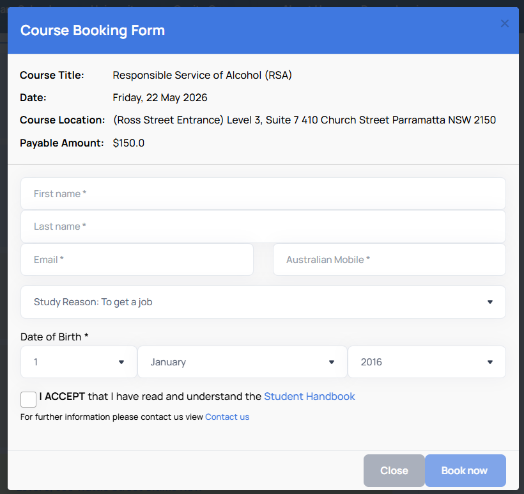 Once your booking (registration / inquiry) has been completed, you will receive an email and text message confirming your registration for the session.
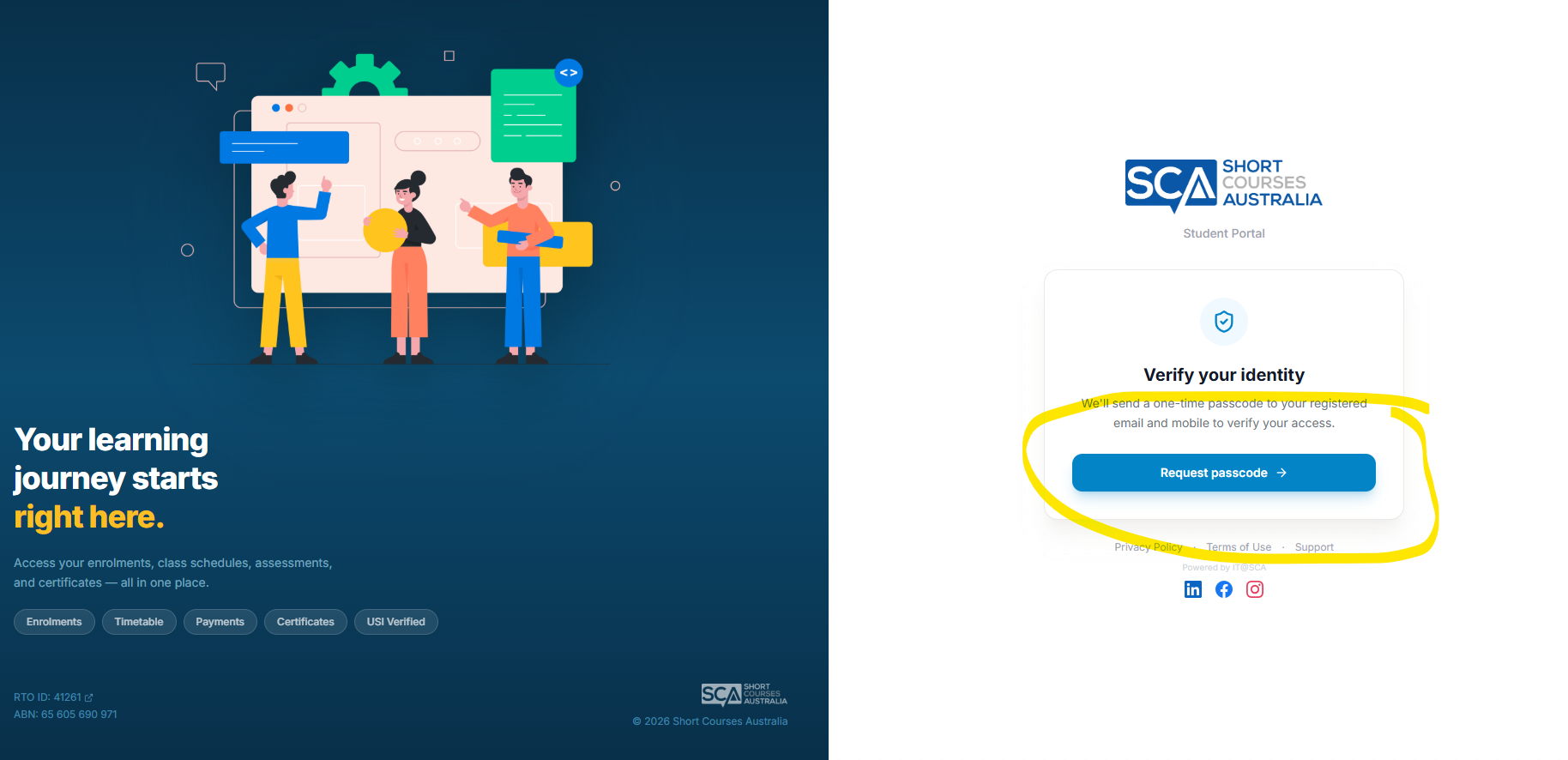
Figure 1 Home page - Student Portal
These messages will take you to you booking confirmation page. (Student Portal see above) within this section each student must complete three (3) important steps.
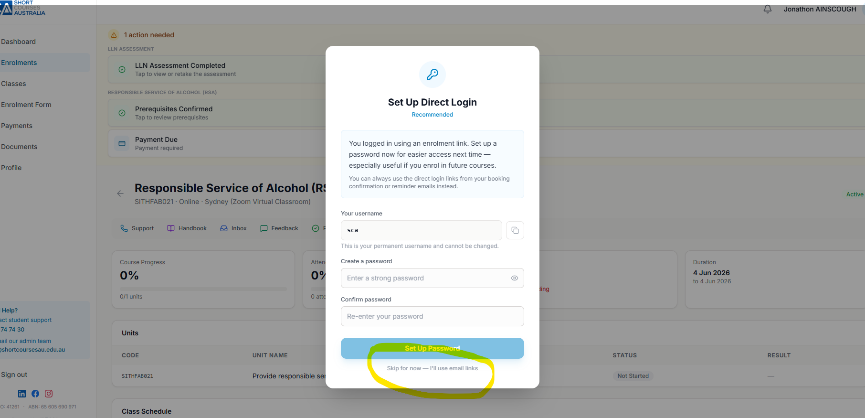
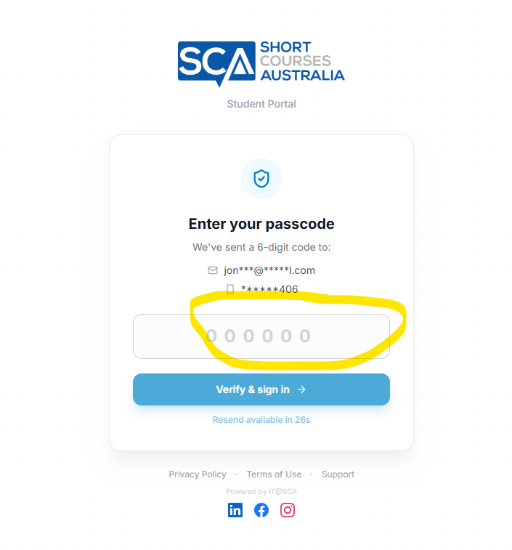 For Privacy reasons students must request a passcode, via text or email (used as part of the booking process)
Figure 2 Verification StepFigure 3 - Set up direct login or Skip
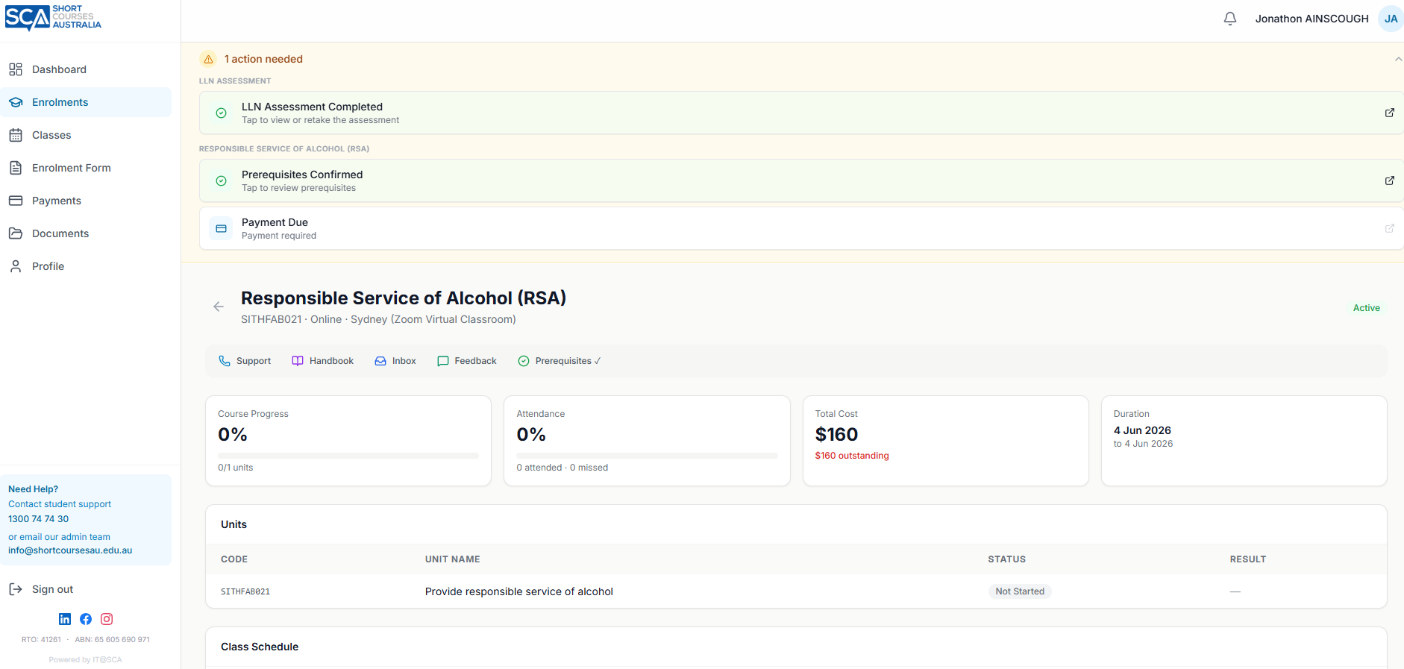
Step 1 - LLND Assessment required. Each student must first complete this to determine is the training product suits the learners need and requirements.
Step 2 – Prerequisites Required: This section is actioned if any course has any specific pre-requisites attached to the specific program.
Step 3 – Complete all full enrolment data and confirm you enrolment into the program / course
During the enrolment process, students are encouraged to identify any support needs, accessibility requirements, wellbeing considerations, preferred names, preferred pronouns or cultural considerations that may assist SCA in providing an inclusive and supportive learning experience.
Information provided will be treated respectfully and may be used to identify suitable learner support services, reasonable adjustments, referral pathways and other assistance required to support successful participation in training and assessment.
Students are encouraged to advise SCA during the enrolment process if they have previously completed nationally recognised training that may be eligible for Credit Transfer.
Information regarding Recognition of Prior Learning (RPL), Recognition of Current Competencies (RCC) and Credit Transfer is available prior to enrolment and throughout the learner journey. Students may discuss available recognition options with SCA staff and may apply for Credit Transfer before enrolment, during enrolment or at any stage throughout their training.
Step 4 – Payment of Fees
Following completion of the enrolment process, students will be required to make payment in accordance with the applicable course fee requirements.
For courses with a total advertised fee of less than $300, full payment is required at the time of enrolment.
For courses with a total advertised fee of $300 or more, students are required to pay a minimum deposit of 25% of the course fee at the time of enrolment. The remaining balance must be paid prior to course commencement unless alternative arrangements have been approved by SCA.
A student's enrolment will not be considered confirmed until the required payment or deposit has been received and processed by SCA.
Student Portal
Each student will gain access to their own independent Student Portal
To access your student portal, you can access via any email or text message sent from SCA to a student, or via our website https://shortcoursesau.edu.au
Access to each student’s portal will require a two-step verification process each time logging in, to ensure privacy, this includes either email or text message communication.
Students may also create a unique login details for longer course / programs.
The Student Portal may also be used to access enrolment information, learner support resources, student documentation, learning materials, Recognition of Prior Learning (RPL) and Credit Transfer information, feedback opportunities and important communications throughout the student journey.
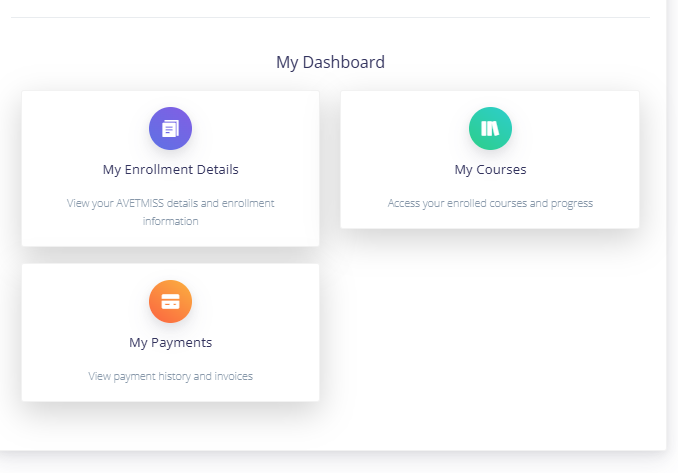 Within the Student Portal you can:
-
view each program or course enrolled into including dates, times.
- Including view course log ins, pre course activities or any resources required for a specific course
- view invoices, deposits, payment schedules and make payments;
- view outstanding balances and payment history;
- access enrolment-related communications and payment reminders;
- edit or update individual students enrolment details
- access forms and information relating to Recognition of Prior Learning (RPL) and Credit Transfer;
- access learning materials, learner resources and course information relevant to your training product;
The Student Portal serves as a central location for enrolment management, student communications, payment administration and access to training resources. Students are encouraged to regularly review their Student Portal to ensure enrolment information, payment obligations and course requirements remain current.
Student communications
SCA communicates with students through a range of approved communication channels, including email, SMS, telephone, the Student Portal, online learning platforms and the SCA website.
Students are responsible for ensuring their personal details remain accurate and up to date throughout their enrolment. This includes email addresses, mobile telephone numbers, residential addresses and any other contact information required by SCA.
Important information relating to enrolments, course schedules, payments, assessments, learner support services, regulatory requirements, course updates and certification may be communicated through one or more approved communication channels.
Fees
The total cost of each course is listed on the relevant course page of the SCA website and within the Student Portal during the enrolment process.
Payment requirements vary depending on the course fee:
- Courses with a total fee below $300 require full payment at the time of enrolment.
- Courses with a total fee of $300 or more require a minimum deposit of 25% at the time of enrolment.
- Any remaining balance must be paid prior to course commencement unless otherwise agreed by SCA.
The payment portal accepts VISA, Mastercard, PayPal, Afterpay and direct bank transfer. An automated receipt (Tax Invoice) will be issued once payment has been successfully processed.
Payments are required at the time of enrolment in accordance with SCA's published payment requirements. Students can make payment through the Student Portal or the Short Courses Australia website using the available payment methods. A confirmation and tax invoice will be issued once payment has been successfully processed.
Enrolment Form
An enrolment form (either via paper or digitally) must be fully completed prior to the commencement of training. This includes supplying SCA with your Unique Student Identifier (USI). (See USI below)
Once all enrolment forms have been completed, you will be enrolled into the course and a trainer and assessor assigned to help you through the course. Note that enrolment is not confirmed until the required payment, deposit or approved payment arrangement has been received and accepted by SCA. Students remain responsible for paying any outstanding balances by the applicable due date.
A Language, literacy, numeracy and Digital Literacy tool must be completed prior to commencement of your course. You can complete this either online within your enrolment / registering process or in-class prior to commencement of study.
Short Courses Australia operates on a system of rolling start dates for some courses. This means you are able to enrol and start studying straight away. Visit: www.shortcoursesau.edu.au or call 1300 74 74 30 email: info@shortcoursesau.edu.au for more information.
Entry Requirements
Please check the website or contact Short Courses Australia to confirm any pre-requisites that are required for entry to the course in which you are interested. Entry requirements may relate to things such as:
- Previous workplace experience
- Previous completion of another qualification that is specified as a pre-requisite for a course.
- Levels of language, literacy, numeracy skills and digital skills appropriate for successful completion of the coursework and also, for effective performance in the workplace in the specific job-role
- Access to a relevant workplace and job-role where the required competencies can be learned and practiced.
- Access to an internet capable device that has appropriate software and capacity to access learning and assessment materials.
- Access to course specific materials such as personal protective equipment (PPE) or other tools of trade.
Where a learner identifies additional support needs, SCA will work with the learner to determine whether appropriate support, reasonable adjustment or referral services can be provided to assist participation and successful completion of the course.
Where appropriate, SCA may provide information about available support services prior to enrolment to assist learners in making an informed decision about their training.
As part of the enrolment process, SCA may review a learner's skills, capabilities, prior experience, support needs and vocational goals to determine whether the selected training product is appropriate for the learner.
Where support needs are identified, SCA will discuss available support options, reasonable adjustments and learner assistance strategies prior to enrolment.
Information Available Prior to Enrolment
Before confirming enrolment, SCA provides prospective learners with access to information that supports informed decision-making. This information may include:
- training product codes and titles;
- entry requirements and prerequisite requirements;
- delivery modes and attendance expectations;
- course duration and assessment requirements;
- information regarding training product transitions, superseded training products and any transition arrangements that may affect learner progression, course completion or certification outcomes where applicable;
-
fees, charges, payment arrangements, deposit requirements and refund conditions, including:
- courses with a total fee below $300 requiring full payment at enrolment;
- courses with a total fee of $300 or more requiring a minimum 25% deposit at enrolment;
- payment due dates and any approved payment arrangements;
- circumstances where enrolment may not be confirmed due to non-payment; and
- applicable refund, transfer and rescheduling conditions.
- learner support services and reasonable adjustment options;
- Recognition of Prior Learning (RPL), Recognition of Current Competencies (RCC) and Credit Transfer opportunities, including eligibility requirements, application processes, evidence requirements, applicable fees (where relevant) and information on how recognition outcomes may affect course duration and training requirements;
- complaints and appeals processes;
- student rights and responsibilities; and
- any relevant third-party arrangements.
SCA is committed to ensuring learners are able to make informed enrolment decisions. Prior to enrolment, students will be provided with clear information regarding course fees, deposit requirements, payment timeframes, refund conditions and any financial obligations associated with their chosen course
Prospective learners are encouraged to review all available information and seek clarification from SCA before enrolling to ensure the training product is suitable for their individual needs, goals and circumstances.
Unique Student Identifier (USI)
A USI is required by all Australians undertaking nationally recognised training. It allows students to link to a secure online record of all qualifications gained regardless of the provider. This system was implemented by the Australian Government in 2015, so it will show student accredited course achievements from 1 January 2015 onwards.
Under the Student Identifiers Act 2014 and Student Identifiers (Exemptions) Instrument 2014, if a USI has not been obtained then AQF certification cannot be issued, which means that Short Courses Australia cannot issue a Statement of Attainment without a USI. Therefore, it is mandatory that all students supply their USI upon confirmed
enrolment.
Student Identifiers Amendment (Enhanced Student Permissions) Act 2020
The Unique Student Identifier scheme commenced on 1 January 2015, following the passage of the Student Identifiers Act 2014.
On 26 May 2020, the Student Identifiers Amendment (Enhanced Student Permissions) Act 2020 came into effect, amending the Student Identifiers Act 2014.
The amendments allow a student or person who has studied VET after 1 January 2015 to choose whether a licensing body, employment agency or potential employer views their authenticated VET transcript.
The student controls:
- Whether to share their transcript or not
- Who gets access
- Which of their VET achievements are displayed
- How long the transcript can be looked at.
The student can remove this access at any time. Giving students this ability and choice increases transparency in the sector and reduces regulatory burden during employment recruitment processes and applications for funding, making it easier to verify VET qualifications.
The amendments also introduce civil penalties to protect the integrity of the student identifier and authenticated VET transcript and to deter persons from doing the wrong thing.
Students may also choose to provide SCA with access to their authenticated USI Transcript to support Credit Transfer applications. The USI Transcript can assist SCA in verifying nationally recognised training outcomes, qualifications and Statements of Attainment previously completed with other Registered Training Organisations (RTOs).
Where permission is provided, SCA may use information contained within a student's USI Transcript to support the assessment and verification of Credit Transfer applications. Additional verification activities may be undertaken where required to confirm the authenticity of training outcomes.
If you do not have a USI, please visit https://www.usi.gov.au/students/create-your-usi for more information and instructions on how to apply. If you are unsure as to whether or not you have a USI, please check that box on your enrolment form and we can search for it, on your behalf. There is a USI Student Quick Guide in the appendix for your information as well.
Just as Short Courses Australia has a responsibility to meet expectations of students, legislation, and regulations, so too, do students have obligations they are expected to meet. It is expected that students will participate with commitment in their studies, regularly submit assessment items, and behave in a manner that does not contravene workplace health and safety or the principle of respect for others.
Short Courses Australia views student misconduct seriously, this includes behaviour that undermines diversity, inclusion, accessibility or cultural safety. We expect that our students will behave in an honest, respectful manner appropriate for a learning environment, and in a way that will uphold the integrity of the RTO. Consequences of student misconduct vary up to and including expulsion from the course. Examples of student misconduct include, but are not limited to:
- Academic misconduct including plagiarism and cheating.
- Harassment, bullying, discrimination, victimisation or behaviour that creates an unsafe, inclusive or culturally unsafe learning environment.
- Falsifying information
- Any behaviour or act that is against the law.
- Any behaviour that endangers the health, safety and wellbeing of others
- Intentionally damaging equipment and/or materials belonging to Short Courses Australia and/or a partner organisation such as a school or workplace.
Consequences for misconduct will depend on the severity and frequency of the breach and include, but are not limited to:
- Formal reprimand (warning)
- Suspension from the course
- Student to reimburse the costs incurred by any damage caused.
- Cancellation of the course without refund and/or credit
- Matter referred to the police.
SCA expects all students to contribute to a respectful, inclusive and culturally safe learning environment. Students are expected to treat fellow learners, staff, visitors and stakeholders with dignity, courtesy and respect.
Students who experience or witness inappropriate behaviour, discrimination, harassment, bullying, victimisation or cultural safety concerns are encouraged to report the matter through SCA's Feedback, Complaints and Appeals processes.
Academic Misconduct
Plagiarism and cheating are serious offences. Students engaging in this behaviour will face disciplinary action.
Students found guilty of misconduct have a right to lodge an appeal by following our Grievance/Complaints and Appeals process.
Visit: www.shortcoursesau.edu.au or call 1300 74 74 30 email: info@shortcoursesau.edu.au
Third-Party Arrangements
If SCA engages a third party to provide recruitment, enrolment, training, assessment, learner support or other services relevant to your course, you will be advised prior to enrolment.
Information provided will clearly identify the role of the third party and the services they are responsible for delivering. SCA remains responsible for the quality and compliance of training and assessment services delivered on its behalf and for ensuring that information provided to learners is accurate and consistent.
Where a third-party arrangement may affect your learner experience, this information will be disclosed before enrolment. If a third-party arrangement ceases or changes during your enrolment, SCA will communicate any impacts and available options as soon as practicable.
Legislation
As an RTO, Short Courses Australia is required to adhere to legislation designed to uphold the integrity of nationally recognised qualifications. This includes:
- National Vocational Education and Training Regulator Act 2011
- Standards for Registered Training Organisations (RTOs) 2025
Additionally, Short Courses Australia abides by a range of other legal requirements at a State and Commonwealth level including, but not limited to:
- Anti-discrimination
- Apprenticeships and Traineeships
- Children and Young People
- Copyright
- Corporations
- Employment and Workplace Relations
- Equal Opportunity
- Fair Work (including harassment and bullying)
- Privacy and Personal Information Protection
- Student Identifiers
- Taxation
- Workplace Health and Safety
Short Courses Australia is dedicated to following the provisions in the VET Quality Framework.
More information about these regulations and legal frameworks can be found at:
- www.comlaw.gov.au which is the Australian Government website for Commonwealth Law
- www.asqa.gov.au which is the website for the regulator of Australia’s vocational education and training (VET) sector.
Short Courses Australia (SCA) is committed to providing a learning environment where students feel safe, respected, heard and supported.
SCA encourages students, staff, stakeholders and members of the public to raise concerns, provide feedback and access complaints and appeals processes where issues arise.
Students are encouraged to provide both positive and constructive feedback regarding their training, assessment, learner support services and overall experience. Feedback may be provided at any stage of the learner journey and is used by SCA to support service improvement, quality assurance and continuous improvement activities.
Complaints and appeals are managed fairly, respectfully, confidentially where appropriate, and in a timely manner.
SCA understands that on occasion, there may be instances of dissatisfaction and acknowledges that the cause(s) must be addressed and rectified promptly. We at SCA are committed to fostering a learning environment where VET students feel heard, respected, and supported, reinforcing Short Courses Australia SCA’s broader commitment to student wellbeing, equity, and quality assurance..
Short Courses Australia acknowledges that a complaint may also come from clients, external stakeholders and the general public and will treat each complaint equally as urgent and important.
Short Courses Australia invites feedback from the dissatisfied party so that a resolution can be found. These situations will also be used as an opportunity to improve SCA’s policies, processes, and services.
Short Courses Australia will address all complaints in a fair, constructive, and timely manner. The complainant has the right for their grievance to be heard and for an impartial decision to be made at no cost to them (unless the complainant seeks an outside resolution service upon their own accord). Complainants have the right to appeal any decision.
There is no cost to access the internal complaints and appeals process. Students may raise concerns relating to discrimination, harassment, bullying, victimisation, accessibility barriers, learner support, wellbeing or cultural safety without fear of disadvantage or retaliation.
No student, staff member, stakeholder or public member will be disenfranchised in any way during the complaint and resolution process. A student’s progress through a study program will not be disrupted whilst a complaint is being heard unless the nature of the issue itself means further progress is not possible.
SCA recognises that complaints and feedback may identify opportunities to improve learner support, diversity, inclusion, cultural safety, accessibility and service quality. Outcomes arising from complaints and appeals may be incorporated into SCA's continuous improvement processes.
Key things to know.
If you feel as though you have been unjustly treated or that a member of our staff, student community or other affiliates have in any way acted in a manner that is beyond our code of conduct then you may seek to have this reviewed and actioned by our administration.
Reasons for a grievance may include:
- Assessment process and decision
- Recognition of Prior Learning (RPL), Recognition of Current Competencies (RCC) and Credit Transfer decisions
- Student progress and academic progress decisions
- Course advice and enrolment
- Customer service and administration
- Equity and access, discrimination, harassment and bullying
- Fees and charges
- Issue of results, certificates, statement of attainment
- Learning and assessment resources
- Marketing and promotional activity
- Personal safety
- Program delivery or course content
- Suspension and/or cancellation or deferral of enrolment
- Cultural safety, diversity, inclusion or accessibility concerns
Some examples
- In the case of an assessment appeal, an assessor who is independent from the original decision will assess the original task again. The outcome of this assessment will be the result granted for the assessment task. The complainant or appellant will be advised in writing of the outcome of the process and the reasons for the findings made.
- Issue of results, certificates, statement of attainment , in some cases there may be a delay in issuing a certificate due to payment status, in some cases we will issue prior to payment
Complaints about a particular incident should be made as soon as possible after the incident occurring and appeals must be made within thirty (30) calendar days of the original decision being made.
Complaints and appeals must be made in writing using the Complaints and Appeals Form, or other written format and sent to Short Courses Australia ’s head office at Address attention to the Chief Executive Officer.
- When making a complaint or appeal, provide as much information as possible to enable.
-
Short Courses Australia to investigate and determine an appropriate solution. This should include:
- The issue you are complaining about or the decision you are appealing – describe what happened and how it affected you.
- Any evidence you have to support your complaint or appeal.
- Details about the steps you have already taken to resolve the issue.
- Suggestions about how the matter might be resolved.
Timeframes for resolution
- The complaint or appeal will be acknowledged in writing within 3 business days.
- The complaints and appeals process will commence within 10 business days of receipt of the application.
- Complaints and appeals will be finalised as soon as practicable or within 30 calendar days.
- Where additional time is required, the complainant or appellant will be advised in writing and provided with regular progress updates.
Resolution of complaints and appeals
- Some or all members of the management team of Short Courses Australia will be involved in resolving complaints and appeals as outlined in the procedures.
- Where a complaint or appeal involves another individual or organisation, they will be given the opportunity to respond to any allegations made.
Student appeals
Students are entitled to formally appeal the outcome of their assessment decision by completing the Appeals Form, stating their case and providing as much detail as possible, and submitting this to the SCA RTO Manager by email or post.
Where possible, appeals will be reviewed by a person independent of the original decision to ensure procedural fairness.
We understand the importance of Grievance/Complaints and Appeals and promote the actioning of concerns in a timely manner, if you would require further information or to speak with someone.
Visit: www.shortcoursesau.edu.au or call 1300 74 74 30 email: info@shortcoursesau.edu.au
Under the Workplace Health and Safety Act 2011, Short Courses Australia must provide a safe environment for both staff and students, as well as providing information to staff and students in relation to health and safety and welfare. Short Courses Australia has policies and procedures in place to ensure your safety and on commencement of your course you will be provided with information about health and safety.
Students undertaking workplace placements must comply with the workplace health and safety
requirements of both SCA and the host organisation.
SCA is committed to ensuring that facilities, equipment, learning resources and training environments used for training and assessment are safe, suitable and fit for purpose. Students are expected to follow all safety instructions and report any hazards, risks, damaged equipment or safety concerns to their trainer, assessor or supervisor as soon as practicable.
Any workplace incident, injury, hazard, wellbeing concern or safety concern occurring during placement activities should be reported to the workplace supervisor and SCA as soon as practicable.
As a student you also have a responsibility to follow instructions and rules and to behave in ways that are safe and do not endanger the health and safety of others. Always ensure that you:
- Immediately report hazards to your trainer/assessor.
- Seek assistance from a member of staff if you become ill or injured on campus.
- Only assist another person who is ill or injured if it is safe to do so. If you’re not sure, call on a member of staff for assistance.
- Incident reports are completed for all WHS incidents as per our Policies and Procedures
- Ensure you are familiar with Short Courses Australia emergency evacuation procedures and in the case of an emergency, follow the instructions given to you.
- Do not leave bags or personal belongings lying around where someone else could trip over them.
- Do not smoke or drink alcohol on the premises.
- Observe basic hygiene practices such as hand washing before handling and eating food and leaving toilets and wash basins clean and tidy, etc).
We understand the importance of Workplace Health and Safety if you would require further information or to speak with someone.
Visit: www.shortcoursesau.edu.au or call 1300 74 74 30 email: info@shortcoursesau.edu.au
Harassment, victimisation, or bullying.
Under the following acts of parliament Age Discrimination Act 2004 , Disability Discrimination Act 1992, Racial Discrimination Act 1975, Sex Discrimination Act 1984 and the Australian Human Rights Commission Act 1986 Short Courses Australia must provide a safe environment for both staff and students, as well as providing information to staff and students in relation to health and safety and welfare. Short Courses Australia has policies and procedures in place to ensure your safety and on commencement of your course you will be provided with information about health and safety.
Short Courses Australia is committed to providing all people with an environment free from all forms of harassment, victimisation, and bullying. Short Courses Australia will not tolerate any behaviour that harms, intimidates, threatens, victimises, offends, degrades, or humiliates another person.
SCA is committed to fostering a learning environment that is safe, inclusive, accessible and culturally responsive for all learners. Behaviour that undermines diversity, inclusion, accessibility or cultural safety will not be tolerated.
Anti-discrimination law defines harassment as any form of behaviour that you do not want, that offends, humiliates, or intimidates you and that creates a hostile environment. Examples of harassment are making fun of someone, spreading rumours, offensive jokes, ignoring someone, etc.
Victimisation is where a person is treated unfairly because they have made a discrimination complaint.
Bullying is verbal, physical, social, or psychological abuse by a staff member or student. Bullying falls under health and safety legislation.
If you experience or witness harassment, victimisation, bullying, discrimination, exclusion, accessibility barriers or cultural safety concerns involving a staff member, student or other stakeholder, you are encouraged to seek support and report the matter through SCA's Feedback, Complaints and Appeals processes.
If you feel that you are being harassed, victimised, or bullied, ideally you should tell the person that you don’t like the behaviour and ask them to stop. However, if you are not comfortable doing this, you should lodge a complaint as per Short Courses Australia Complaints and Appeals procedure.
All reports are treated seriously and handled fairly, respectfully and, where appropriate, confidentially. SCA encourages early reporting of concerns to support timely resolution and a safe learning environment for all learners.
We at SCA take harassment, victimisation, or bullying of a high importance and promote the actioning of concerns in a timely manner.
Visit: www.shortcoursesau.edu.au or call 1300 74 74 30 email: info@shortcoursesau.edu.au
Equal opportunity
Under the EEO Amendment Act 2011, Short Courses Australia must provide a safe environment for both staff and students, as well as providing information to staff and students in relation to health and safety and welfare. Short Courses Australia has policies and procedures in place to ensure your safety and on commencement of your course you will be provided with information about health and safety.
Short Courses Australia is committed to providing a learning environment that promotes diversity, inclusion, accessibility, equity and cultural safety.
SCA seeks to ensure that all prospective and current students, staff, clients and stakeholders are treated fairly, respectfully and without discrimination, regardless of their background, culture, language, age, gender, disability, religion or personal circumstances.
All learners are entitled to equitable access to training, assessment, support services and learning opportunities.
SCA recognises that learners may have different learning needs and support requirements and will work with learners to identify reasonable and appropriate support measures.
This may include reasonable adjustments, additional learner support, flexible learning arrangements, referral to support services and access to appropriate learning resources.
SCA values the contribution of diverse learners and aims to create an environment where all learners can participate, engage and succeed.
We at SCA take Equal opportunity of a high importance and promote the actioning of concerns in a timely manner, if you would require further information or to speak with someone.
Visit: www.shortcoursesau.edu.au call 1300 74 74 30 email: info@shortcoursesau.edu.au
Smoking, Drugs and Alcohol
Short Courses Australia is a smoke-free workplace. Smoking is prohibited in all buildings and only permissible at designated locations away from building entrances; there is to be no smoking within four metres of a building entrance.
Any student under the influence of drugs and/or alcohol is not permitted on Short Courses Australia premises, to use Short Courses Australia facilities or equipment, or to engage in any Short Courses Australia activity.
People taking prescription medication have a duty of care to ensure that their own safety, and that of others, is not affected.
Further Information about our Smoking, Drugs and Alcohol policy is documented clearly on our website at www.shortcoursesau.edu.au or call 1300 74 74 30 email: info@shortcoursesau.edu.au
Short Courses Australia (SCA) values diversity and is committed to providing a learning environment where all learners are treated with dignity, fairness and respect.
SCA recognises that learners bring diverse backgrounds, experiences, perspectives and identities that enrich the learning environment and contribute to positive educational outcomes.
SCA promotes equitable access to training, assessment and support services and is committed to fostering an inclusive learning environment where all learners feel safe, respected and supported.
The following principles guide SCA's approach to diversity, inclusion and cultural safety:
Respect for Identity
Cultural, linguistic, religious, gender, age and ability diversity is recognised, respected and valued.
Cultural Safety for Aboriginal and Torres Strait Islander Peoples
The learning environment actively supports cultural recognition, understanding, inclusion and cultural safety.
Accessibility and Inclusion
SCA supports equitable participation through inclusive practices, learner support services and reasonable adjustments where appropriate.
Zero Tolerance for Discrimination
Discrimination, harassment, bullying, victimisation and exclusion will not be tolerated.
Access and Equity (Diversity and Inclusion)
Short Courses Australia (SCA) is committed to providing a learning environment that is safe, inclusive, accessible and culturally responsive for all learners.
SCA values diversity and promotes equitable access to training, assessment and support services. Learners are treated with dignity, fairness and respect regardless of their background, culture, language, age, gender, disability, religion, personal circumstances or other characteristics.
SCA recognises that learners may have different support needs and is committed to creating an environment where all learners can participate, engage and succeed in their training.
SCA supports cultural safety for Aboriginal and Torres Strait Islander peoples and promotes inclusive practices that foster respect, participation and belonging.. Short Courses Australia prohibits discrimination based on factors including:
- Gender
- Age
- Marital status
- Sexual orientation
- Race
- Ethnicity
- Religious background
- Parental status
Short Courses Australia SCA will work with learners to identify and address barriers to participation wherever reasonably practicable.
Support may include:
- reasonable adjustments to training or assessment activities;
- additional trainer or learner support;
- flexible learning or assessment arrangements;
- referral to internal or external support services;
- accessible learning materials and resources; and
- assistance to address language, literacy, numeracy or digital literacy needs.
Short Courses Australia recognises that life can throw up many challenges that can hinder your ability to participate and complete your studies. Short Courses Australia will work with you overcome those challenges, and support may include:
- Allowing extra time to complete studies or undertake assessments.
- Providing extra teaching support
- Adjusting assessment activities to accommodate disabilities.
- Refer you to outside support organisations.
It is the responsibility of all staff at Short Courses Australia to uphold our commitment to Access and Equity principles, the policy can be found on the Short Courses Australia website.
Students who experience or witness discrimination, harassment, bullying, victimisation, accessibility barriers or cultural safety concerns are encouraged to seek support and raise their concerns through SCA's Feedback, Complaints and Appeals processes.
SCA adopts a zero-tolerance approach to unlawful discrimination, harassment, bullying and victimisation.
SCA recognises that learners may have different support requirements and will work with learners to identify and implement suitable assistance strategies, reasonable adjustments and support services where appropriate.
Student Wellbeing Support
Short Courses Australia (SCA) recognises that student wellbeing is important to successful participation, engagement, progression and achievement in training.
SCA is committed to providing a safe, inclusive, accessible and supportive learning environment and recognises that wellbeing factors may influence a learner's ability to participate and succeed in training and assessment.
SCA proactively identifies the wellbeing needs of its student cohorts and implements appropriate strategies, support services and referral pathways to support student wellbeing, engagement and success.
SCA fosters a supportive training environment that prioritises student wellbeing through accessible support services, wellbeing resources, referral pathways, safety guidance and student engagement initiatives.
Students are encouraged to seek support early where personal, emotional, cultural, social, psychological, health, wellbeing, accessibility or other circumstances may affect their participation, progress or success.
SCA proactively seeks to identify the wellbeing needs of its student cohorts and encourages learners to discuss any wellbeing, accessibility, personal, cultural, social or support needs that may affect their participation in training.
Students may disclose support needs during enrolment, throughout training and assessment, during workplace or vocational placement activities where applicable, or at any other stage of their learner journey. Early identification of support needs assists SCA to provide appropriate support services, referral pathways, reasonable adjustments and wellbeing assistance where required.
Where appropriate, SCA may provide support directly or assist learners to access suitable internal or external support services.
Wellbeing support may include:
- learner support and guidance;
- accessibility and reasonable adjustment support;
- wellbeing information and resources;
- referral to internal support services;
- referral to external specialist services where appropriate; and
- information regarding crisis and emergency support services.
Students can access wellbeing support information through the SCA website, Student Portal, Student Handbook and by speaking with a trainer, assessor or member of the Student Support team.
Further information is available via: https://shortcoursesau.edu.au/student-support
These services are also accessible through the Student Portal and are promoted throughout the learner journey to encourage early help-seeking and access to support when required.
Students undertaking workplace placements continue to have access to learner support services, wellbeing support resources, referral pathways and reasonable adjustment arrangements throughout their placement activities.
We understand the importance of supporting and aiding our students if you would require further information or to speak with someone.
Visit: www.shortcoursesau.edu.au or call 1300 74 74 30 email: info@shortcoursesau.edu.au
Other Support Services
Short Courses Australia is at all times concerned for the welfare of its students. If you are experiencing difficulties and/or require counselling or personal support, there are a number of professional organisations well equipped to offer services to help.
Where a student's wellbeing needs exceed the support that can reasonably be provided by SCA, students may be referred to appropriate external support services, health professionals, community organisations or specialist support providers.
These services are free to access and are independent from Short Courses Australia. These include:
Lifeline: 13 11 14 or www.lifeline.org.au & Beyond Blue: 1300 22 4636 or www.beyondblue.org.au
Some qualifications, accredited courses, skill sets or units of competency may include workplace, vocational or professional placement requirements.
Prior to the commencement of placement activities, SCA may review the suitability of workplace facilities, equipment, supervision arrangements, workplace resources and safety controls to ensure the placement environment supports the requirements of the training product and student learning outcomes.
Prior to placement commencement, SCA may review the suitability of host organisations, workplace environments, supervision arrangements, workplace resources and safety considerations to ensure the placement supports student learning outcomes and training product requirements.
During placement activities, SCA may maintain communication with students and host organisations, monitor participation and provide learner support, wellbeing support and referral pathways where required.
Placements provide students with opportunities to apply workplace skills and knowledge in an industry environment and contribute towards the achievement of training and assessment outcomes.
Prior to placement commencement, students will be provided with information regarding:
- placement requirements and expectations;
- workplace health and safety obligations;
- workplace conduct and professional behaviour requirements;
- required placement documentation and agreements;
- supervision arrangements;
- learner support services available during placement; and
- student wellbeing and referral support services.
Students undertaking placement activities are expected to:
- comply with workplace policies and procedures;
- follow workplace health and safety requirements;
- maintain professional conduct and behaviour;
- participate in workplace learning activities;
- communicate any concerns, incidents or support needs to SCA; and
- comply with placement agreements and related documentation.
Where training or assessment is delivered at employer, client, school, workplace or other third-party venues, students must comply with site-specific requirements, workplace health and safety requirements, emergency procedures and any reasonable directions provided by SCA personnel or authorised site representatives.
Where appropriate, SCA will work with students and host organisations to identify and implement reasonable adjustments and support strategies to facilitate participation in placement activities.
Students continue to have access to learner support services, wellbeing support, referral pathways, complaints and appeals processes and other student support services while undertaking workplace placements.
Short Courses Australia offers assessment processes that enable recognition of competencies currently held, regardless of how, when or where the learning occurred. SCA recognises that students may enter training with existing skills, knowledge, or experience gained through work, informal study, or life experience. These are detailed below:
Recognition of Prior Learning
Recognition of Prior Learning (RPL) is an assessment process that involves making a judgment on the skills and knowledge an individual has as a result of past study and/or experience. SCA provides all prospective and enrolled students with the opportunity to apply for Recognition of Prior Learning (RPL). Students may apply before enrolment, during enrolment or at any stage throughout their participation in training.
Recognition of Prior Learning (RPL) is assessed against the requirements of the relevant training product and may include a review of qualifications, workplace evidence, professional experience, competency conversations, practical demonstrations, challenge assessments and other assessment activities where required.
The aim of RPL is to recognise your existing competencies without having to go through the complete processes of training and assessment. RPL refers to the formal acknowledgement of current skills, knowledge and attitudes held as a result of education and training, work experience and/or life experience. It is essentially an assessment pathway in the Vocational Education and Training system. It is a process that assesses student s’ competency acquired through formal and informal learning to determine if they meet the requirements for a unit of competency.
You will still need to provide evidence though, upon which your assessor can base their judgement. Evidence must be:
- Authentic – it must be your own work.
- Sufficient – it must demonstrate competence over a period of time, that the competencies can be repeated, and the evidence must be enough so that the assessor can make an accurate judgement regarding competency.
- Current – it must demonstrate up-to-date knowledge and skills i.e., from the present or the very-recent past. (within at least a previous 12-month period)
- Valid – it must be relevant to what is being assessed.
You may be eligible to apply for RPL on one or more Units of Competency in your course.
As part of the enrolment process, students are informed of the availability of Recognition of Prior Learning (RPL) and Credit Transfer and are provided with information about how to apply.
Recognition of Prior Learning (RPL) and Credit Transfer are separate processes. Credit Transfer recognises previously completed nationally recognised training outcomes based on authenticated AQF certification documentation or an authenticated VET Transcript. RPL is an assessment process that evaluates a student's existing skills, knowledge and experience gained through formal, non-formal or informal learning against the requirements of a training product.
Students are encouraged to discuss previous qualifications, Statements of Attainment, licences, workplace experience and other relevant evidence prior to commencing training. Trainers and staff will explain the available recognition options, evidence requirements and how RPL or Credit Transfer may contribute towards the attainment of a qualification.
Students may apply for RPL or Credit Transfer before enrolment, during enrolment or throughout their participation in training with SCA.
Please note some courses and course content we offer sit outside and are ineligible for RPL (Recognition of Prior Learning) for example NSW Food Authority (FSS Certificates)
When approached by a student seeking RPL, trainers will:
- Provide the student with copies of an RPL Introduction Letter or Kit;
- Provide the student with information about the types of evidence that can be used to support an RPL application.
Recognition of prior learning fee
The student will be charged 100% of the scheduled course fee. This includes the initial application, consultation either in person or via phone with the suitably qualified assessor, the RPL assessment and (if successful) certification.
Where the student is not able to achieve the full qualification through RPL and gap training is required, a training plan and costing structure will be mutually agreed upon. The basis of the cost structure will be pro-rata on a unit-by-unit basis based on the scheduled course fee.
Students will be provided with information regarding RPL fees, assessment requirements, evidence requirements and any additional assessment activities prior to commencing the RPL process.
Recognition of Current Competencies
Recognition of Current Competencies is a recognition process like RPL. It applies if a student has “…previously successfully completed the requirements for a unit of competency…and is now required to be reassessed to ensure the competence is being maintained”.
We understand the importance of recognising prior/current education (learning) if you would require further information or to speak with someone. Visit: www.shortcoursesau.edu.au or call 1300 74 74 30 email: info@shortcoursesau.edu.au
Credit Transfer
Short Courses Australia (SCA) recognises nationally recognised training outcomes previously achieved by students and provides Credit Transfer for equivalent units of competency and training products where appropriate evidence is provided.
Credit Transfer is a process that recognises nationally recognised training previously completed with a Registered Training Organisation (RTO) or other authorised issuing organisation and grants credit for equivalent units of competency or training products.
Credit Transfer allows eligible students to avoid unnecessary duplication of training and assessment and supports efficient learner progression and course completion.
Students may apply for Credit Transfer before enrolment, during enrolment or at any stage throughout their participation in training with SCA.
To apply for Credit Transfer, students must submit a completed Credit Transfer Application Form together with appropriate supporting evidence. Evidence may include:
- AQF Qualifications;
- Statements of Attainment;
- Records of Results;
- Authenticated VET Transcripts; and/or
- USI Transcript information where permission has been provided.
SCA will verify all evidence before granting Credit Transfer. Verification may include reviewing USI Transcript information and, where necessary, confirming the authenticity of evidence with the issuing organisation.
There is no fee for Credit Transfer applications.
Where Credit Transfer is granted, SCA will update student records, enrolment details and training requirements accordingly.
Where a Credit Transfer application is partially approved or declined, SCA will advise the student of the outcome and provide information regarding the Complaints and Appeals process.
Students should note that licensing, industry, regulatory or jurisdictional requirements may affect the availability of Credit Transfer for some training products.
Credit Transfer and Recognition of Prior Learning (RPL) are different processes. Credit Transfer recognises previously completed nationally recognised training outcomes, while RPL assesses skills, knowledge and experience gained through formal, non-formal or informal learning against the requirements of a training product.
Information about Credit Transfer is documented on our website Visit: www.shortcoursesau.edu.au or email a copy of your certified transcript including your booking information to: info@shortcoursesau.edu.au
Course Information
After enrolment, students will be provided with access to relevant training materials in hard copy and/or digital format through the Student Portal, Learning Management System (where applicable), or other approved delivery methods. SCA supplies all required course materials, resources and equipment necessary for participation in training unless otherwise advised prior to enrolment.
Students will receive enrolment confirmations, course reminders, training information and other important communications through the Student Portal, email, SMS and other approved communication channels. Students are encouraged to ensure their contact details remain current throughout their enrolment to support the timely delivery of important information.
You will be provided with information relating to your course, including:
- training schedules and session information;
- venue details or online training access information;
- course requirements and assessment activities;
- learner support services and available resources;
- pre-course activities and enrolment requirements; and
- important policies, procedures and student information relevant to your training.
Training and assessment delivery arrangements may vary between training products and learner cohorts. Details relating to delivery modes, schedules, training locations, assessment requirements and learner support arrangements will be provided prior to or upon commencement of training.
Where a training product is superseded, replaced, removed or otherwise changed during a student's enrolment, SCA will communicate available options, applicable transition requirements and any impacts on training, assessment or certification outcomes as soon as practicable.
Duration
Most of Short Courses Australia programs are less than one day long. There are a couple of exceptions to this, which means that you may be required to work outside of the in-class times assigned to you. How long your course will take depends on several factors.
These are: your own efforts and commitment to submitting assessments regularly and on time, your study load (i.e., full- or part-time), whether or not assessment is conducted in a workplace, and any approved Recognition of Prior Learning (RPL), Recognition of Current Competencies (RCC) and/or Credit Transfer outcomes.
Where Recognition of Prior Learning (RPL), Recognition of Current Competencies (RCC) or Credit Transfer is granted, the amount of training and assessment required may be reduced. Approved recognition outcomes may therefore affect a student’s training requirements, enrolment arrangements and overall course duration. Students will be advised of any such changes following assessment of their application.
Where training product transition arrangements apply, course duration, training requirements, enrolment arrangements or certification outcomes may be affected. SCA will communicate any required changes and provide students with information regarding available options and applicable transition requirements.
Further, the level of the qualification being undertaken will impact on course duration. The Australian Qualifications Framework (AQF) summarises the criteria of different qualification levels and gives an indication of the complexity, depth of achievement, knowledge, skills and levels of autonomy required to achieve a qualification at that level.
Attendance
SCA expects students to attend and actively participate in all scheduled training and assessment activities to maximise learning outcomes and support successful course completion. Students are responsible for attending all scheduled sessions, completing required activities and meeting any attendance requirements that apply to their course.
Where valid reasons for absence exist, students should notify SCA as soon as practicable prior to the commencement of the scheduled session. Notification may be made via phone, email, SMS or other approved communication channels.
Attendance may be recorded using a variety of approved methods, including attendance sheets, online participation records, electronic attendance systems, session monitoring records and Student Management System reporting tools.
SCA may record attendance outcomes using classifications such as:
- Absent – where a student is unable to attend a scheduled session that forms part of a multi-session training program and alternative arrangements may be available.
- No Show – where a student does not attend a scheduled training session, fails to notify SCA prior to commencement, or does not attend a single-session course where make-up training cannot reasonably be provided.
Students who do not attend scheduled training sessions without notification may be contacted by SCA staff to discuss attendance, support requirements, rescheduling options or enrolment status.
For some courses, licensing requirements, regulatory obligations or training product requirements may prevent students from participating where attendance requirements are not met, where a student arrives after the permitted commencement time, or where mandatory training and assessment activities have not been completed.
Attendance outcomes may impact eligibility for course transfers, refunds, rescheduling arrangements and course completion requirements in accordance with SCA policies and procedures. Students are encouraged to contact SCA as early as possible if they are unable to attend a scheduled training session.
Course start times
Students are required to either arrive at the training venue or log on to the scheduled online training platform at least 10 minutes prior to the commencement of the training session. This allows time for troubleshooting, if required, and provides students with the opportunity to review any pre-course activities or complete the LLND (Language, Literacy, Numeracy and Digital Literacy) Indicator Tool prior to the commencement of training.
If, for any reason, a student is unable to be at the venue or logged on to the scheduled online training platform within 15 minutes of the commencement time, the trainer may not permit entry into the training session. Due to the nature of many courses delivered by SCA, there is a limited timeframe available to deliver training and assessment activities. Late arrivals may disrupt the learning experience of other students and may impact the student's ability to meet course requirements.
If a student is unable to attend a scheduled class or online session due to lateness, they may be provided with an opportunity to transfer or rebook into another available session in accordance with SCA policies and course requirements.
Due to SCA delivering training in partnership with, or under the requirements of, various licensing and regulatory authorities, including Liquor Control Victoria (LCV), Liquor & Gaming NSW, NSW Food Authority, WorkSafe Victoria and SafeWork NSW, strict attendance requirements may apply. For some courses, students arriving more than fifteen (15) minutes after the scheduled commencement time may not be permitted to participate in the training session.
Students who anticipate being late should contact SCA as soon as possible by calling 1300 74 74 30 or emailing info@shortcoursesau.edu.au to discuss available options.
Nationally Recognised and Non-Accredited Training
SCA delivers nationally recognised training and may also offer non-accredited training, workshops, professional development activities or industry-specific programs where appropriate. Students should review the information provided for each training product to determine whether it is nationally recognised or non-accredited.
Nationally recognised training will identify the relevant training product code and title and may lead to the issuance of an AQF Qualification or Statement of Attainment where all requirements have been successfully met. Non-accredited training does not form part of the Australian Qualifications Framework (AQF) and does not result in the issue of nationally recognised certification unless otherwise stated.
Where a course is non-accredited, SCA will clearly explain the nature of the training and any certificate of attendance or participation that may be issued. Students are encouraged to seek clarification before enrolment if they are unsure of the outcome associated with a particular course or program
Course Information Accuracy
SCA is committed to ensuring that course information provided to prospective and current students is accurate, current and consistent with the services it is authorised to deliver. Where nationally recognised training is offered, training product codes and titles will be identified using the exact code and title published on the National Register (training.gov.au).
Where a training product becomes superseded, replaced, removed or otherwise amended, SCA will update course information, enrolment information, training and assessment information and student communications as soon as practicable to ensure learners receive accurate and current information.
Information relating to course duration, delivery methods, assessment requirements, entry requirements, fees and charges, deposit requirements, payment arrangements, learner support services and certification outcomes is reviewed periodically to support accuracy and informed decision-making.
Where changes are made to course pricing, enrolment requirements, payment arrangements, course terminology, delivery methods or student administration processes, SCA will update relevant websites, enrolment systems, Student Portal information, marketing materials and student communications as soon as reasonably practicable.
Students are encouraged to review current course information and contact SCA if additional clarification is required before enrolment.
SCA regularly reviews training, assessment and learner information to ensure it remains accurate, current and aligned with regulatory requirements, industry expectations and quality assurance activities, including moderation and validation processes.
SCA is committed to ensuring consistency between information published on its website, Student Portal, marketing materials, enrolment systems and Student Handbook. Where discrepancies are identified, SCA will take reasonable steps to review, correct and update the information as soon as practicable. This includes information relating to course fees, deposit requirements, enrolment processes and delivery arrangements
Courses we offer.
Short Courses Australia runs a number of courses. A list is detailed below, for the most up to date list of courses, dates and times please visit our website www.shortcoursesau.edu.au
- SIT20322 Certificate II in Hospitality
- SIT30622 Certificate III in Hospitality
- SIT30821 Certificate III in Commercial Cookery
- CPCWHS1001- Prepare to work safely in the construction industry.
- CPPUPM3008 - Inspect for and report on timber pests.
- CPPUPM3010 - Control timber pests
- HLTAID009 - Provide cardiopulmonary resuscitation.
- HLTAID010 Provide Basic Emergency Life Support
- HLTAID011 - Provide First Aid
- HLTAID012 Provide First Aid in an education and care setting
- ICTWEB306 Develop web presence using social media.
- RIICOM201E Communicate in the workplace.
- RIIHAN301E Operate elevating work platform.
- TLIF0020 Safely access the rail corridor.
- TLILIC003 Licence to operate a forklift truck.
- VU22523 Undertake basics market research and promotion for a small business product or service.
- SITHFAB021 Provide responsible service of alcohol. (L&G NSW + LCV approved)
- New Entrant Liquor License Training (LCV approved)
- SITHGAM022 – Provide responsible gambling services. (L&G NSW approved)
- SITXFSA005 – Use hygienic practices for food safety. (NSW Approval No. 65101)
- SITXFSA006 - Participate in safe food handling practices. (NSW Approval No. 65101)
- VBAISP2020 – Course in Swimming Pool and Spa Inspection
- RIISS00058 Traffic Controller Skill Set for Urban Streets and Low Volume Rural Roads and
- RIISS00060 Traffic Management Implementer Skill Set for Urban Streets and Low Volume Rural Roads
- CPPPUPM3005 (Unit 5) Manage pests without applying pesticides
- CPPUPM3006 (Unit 6) Manage pests by applying pesticides
- CPPUPM3018 (Unit 18) Maintain equipment and pesticide storage area in pest management vehicles
Information about fees and charges is documented clearly on our website at https://shortcoursesau.edu.au/compliance/fees-and-charges or can be obtained by contacting Short Courses Australia.
Short Courses Australia (SCA) is committed to providing clear, accurate and transparent information regarding fees, charges, payment arrangements and refund conditions prior to enrolment.
Students are encouraged to review all fee information before confirming their enrolment to support informed decision-making.
Short Courses Australia operates as a fee for service training business. This means all training programs attract fees. All fees are payable in accordance with SCA's published payment requirements.
- Courses with a total advertised fee of less than $300 require full payment at the time of enrolment.
- Courses with a total advertised fee of $300 or greater require a minimum deposit of 25% at the time of enrolment.
- The remaining balance is payable prior to course commencement unless alternative payment arrangements have been approved by SCA Management.
Payment requirements and due dates are communicated to students before enrolment and commencement of training.
SCA reserves the right to place a hold on enrolments, training participation, certification issuance or other services where required payments have not been made in accordance with agreed terms.
Each course fee includes all course materials, training session by a highly skilled and qualified instructor, and an electronic version of the statement of attainment. Students are guaranteed a minimum of three (3) attempts at any assessment task to gain competency, after this time students will have to enrol in full and pay the full course fee.
- All course fees are listed on the SCA website (www.shortcoursesau.edu.au).
- Payment requirements and due dates are communicated to students prior to enrolment and commencement of training.
- For courses where fees exceed $1,500, SCA will implement any required fee protection arrangements in accordance with applicable regulatory requirements. Deposit and payment arrangements for these courses will be communicated prior to enrolment and may be subject to additional administrative controls or payment schedules.
- Applicable payment schedules and fee protection arrangements will be communicated to students prior to enrolment.
- There are no fees associated with Credit Transfer applications. SCA will provide information and assistance regarding the Credit Transfer process, including the verification of supporting documentation, at no additional cost to the student.
- There are no fees associated with assistance provided by SCA in relation to creating or verifying a Unique Student Identifier (USI).Charges apply to those services not related to the enrolment process. Charges are listed on the website and in the Student Handbook. E.g. Certificate reprint.
- Payments can be made, via electronic bank transfer, Afterpay, Paypal, credit card, over the phone or in person at SCA.
Where a student fails to achieve a satisfactory outcome after three (3) attempts at an assessment task, the student will need to re-enrol into the unit or units in question and will be charged a pro-rata course fee based on the number of units required to be undertaken.
SCA acknowledges its responsibility under the National Vocational Education and Training Regulator (Compliance Standards for NVR Registered Training Organisations and Fit and Proper Person Requirements) Instrument 2025 to protect VET students from financial loss where prepaid fees exceed the threshold of $1,500 per course per individual.
To comply with the regulatory requirements, SCA has adopted the following principles:
- Prepaid fees will only be collected in accordance with approved fee protection arrangements.
- Students will be provided with clear information about all applicable fees and refund arrangements.
- Where fees exceed the threshold, a formal and approved fee protection strategy will be implemented and maintained.
Fee Information Includes
- All fees and charges associated with the course, including tuition fees, materials fees and any mandatory course-related costs.
- Any additional fees that may be payable, including fees associated with Recognition of Prior Learning (RPL), replacement certification documentation or other optional services, where applicable.
- Payment terms and conditions, including deposits, payment schedules, payment methods, refund conditions and any approved payment arrangements.
- Information regarding fee protection arrangements where applicable.
- Information about student rights, consumer protections and access to the Complaints and Appeals process.
Where an employer, organisation or other third-party payer is responsible for course fees, applicable fee arrangements and payment responsibilities will be communicated to the relevant parties prior to enrolment.
There are no fees associated with Credit Transfer applications. Students may apply for Credit Transfer before enrolment, during enrolment or at any stage throughout their participation in training with SCA.
Any fees associated with Recognition of Prior Learning (RPL) will be advised prior to the commencement of the assessment process.
Course Fees
See the Short Courses Australia website for our current fees at www.shortcoursesau.edu.au. Course fees are listed on the individual course information page and alongside the relevant booking and enrolment options.
SCA is committed to providing clear, accurate and transparent information regarding course fees, payment obligations and enrolment requirements prior to enrolment. Students will be advised of all applicable fees, deposit requirements, payment schedules and due dates before confirming their enrolment.
Payment requirements are based on the total advertised course fee:
- Courses with a total advertised fee of less than $300 require full payment at the time of enrolment.
- Courses with a total advertised fee of $300 or greater require a minimum deposit of 25% at the time of enrolment.
- Any remaining balance must be paid prior to the commencement of training unless alternative arrangements have been approved by SCA Management.
- Students will receive confirmation of payments made and details of any outstanding balances through the Student Portal or other approved communication channels.
- Enrolment may not be confirmed until the required payment or deposit has been received and processed by SCA.
Payment requirements, deposit obligations, payment schedules and due dates are communicated to students prior to enrolment and commencement of training. Students are provided with sufficient information to understand their financial obligations before confirming enrolment.
For courses where fees exceed $1,500, SCA will implement any required fee protection arrangements in accordance with applicable regulatory requirements. Deposit and payment arrangements for these courses will be communicated prior to enrolment and may be subject to additional administrative controls or payment schedules.
SCA reserves the right to suspend, cancel or place restrictions on enrolments where payment requirements have not been met in accordance with agreed terms. Consistent with SCA policies, certificates, Statements of Attainment and other certification documentation may be withheld until all outstanding fees have been paid.
Other Fees
Printing of Qualification: Short Courses Australia emails all students an electronic copy of their qualification within five (5) business days so that they have timely access to their certificates. If you require a physical or hard copy of your certificate (this includes wallet sized business card) for employment you will be charged a fee of $30.00 to print and post a copy of your qualification or certificate to you. Please speak with your trainer or contact us on 1300 74 74 30 if a hard copy of your qualification is required.
Replacement of Training Materials: Short Courses Australia will charge a fee to replace any lost training and/or assessment materials that have been previously issued to you. Please speak with your trainer or contact us on 1300 74 74 30 if replacement materials are required.
Re-issue of Transcripts: An administration fee of $30.00 applies for Short Courses Australia to re-issue a copy of your Certificate or Statement of Attainment.
Payment Options: Payment of course fees can be made to Short Courses Australia via:
- Credit card (Visa or Mastercard)
- Online Portal Payment (Afterpay, Paypal, Credit Card or direct Bank Transfer
Fees must be paid in accordance with SCA's published payment requirements.
Students must ensure any required enrolment payment or deposit has been paid prior to confirmation of enrolment. Any remaining course balance must be paid before commencing training unless alternative arrangements have been approved by SCA.
Please note that outstanding fees may result in cancellation or suspension of an enrolment, restriction of access to training or assessment activities, and/or Short Courses Australia withholding the issue of Certificates, Statements of Attainment or other certification documentation until all fees have been paid.
Students experiencing financial difficulty are encouraged to contact SCA as early as possible to discuss alternative payment arrangements where appropriate.
For assistance with course fees, payment arrangements or outstanding balances, please contact Short Courses Australia on 1300 74 74 30 or email info@shortcoursesau.edu.au.
Failure to Make Payment
As per our current policy, if payments are not made in accordance with agreed payment terms, Short Courses Australia may suspend or cancel training, enrolment, course participation or access to student services until payment is received. Failure of the student and/or their representative to meet payment obligations may result in the outstanding debt being referred to a registered debt collection agency. Any fees associated with this service may be added to the total outstanding amount for recovery. No certificates will be issued until full payment has been made.
Where a student has paid an enrolment deposit only, failure to pay the remaining balance by the required due date may result in:
- suspension of enrolment;
- cancellation of a scheduled booking;
- inability to attend training or assessment activities;
- withdrawal of access to training resources where applicable;
- withholding of Certificates, Statements of Attainment or other certification documentation; and
- cancellation of approved payment arrangements.
Students experiencing financial difficulty are encouraged to contact SCA as early as possible to discuss alternative payment arrangements where appropriate. Requests for alternative payment arrangements will be considered fairly and on an individual basis.
SCA will make reasonable efforts to communicate outstanding balances and payment due dates through the Student Portal, email, SMS or other approved communication channels prior to taking any action relating to unpaid fees.
Cancellation Fee: A cancellation fee may apply for withdrawing from a course within forty-eight (48) hours of course commencement. This includes students who attend after the scheduled class cut-off time or fail to attend a scheduled training session.
Refunds
SCA is committed to managing refund requests fairly, consistently and transparently. Refund requests are assessed on an individual basis, taking into consideration the circumstances of the request, services already delivered and applicable fee conditions.
Students who have paid either a full course fee or an enrolment deposit may be eligible for a refund where they withdraw from a course and provide at least forty-eight (48) hours' notice prior to the scheduled course commencement time.
Where a student has paid a 25% enrolment deposit for a course, the deposit may be:
- refunded in accordance with SCA's refund requirements;
- transferred to an alternative course date where available; or
- credited towards another SCA course at the discretion of SCA.
Students who withdraw with less than forty-eight (48) hours' notice, fail to attend a scheduled training session, arrive after the permitted course commencement cut-off time, or do not meet course attendance requirements may be ineligible for a refund unless exceptional circumstances apply. This includes enrolments where only a deposit has been paid.
Students are encouraged to contact SCA as soon as possible to discuss their circumstances and available options, including transfers, rescheduling or course credits.
Refund outcomes will be communicated within a reasonable timeframe. Where a refund request is not approved, students will be provided with information regarding SCA's Complaints and Appeals process.
Where an overpayment has occurred, a refund of the overpayment amount will normally be processed within three (3) business days of notification. Where payment was originally made by credit card, the refund will be returned to the same credit card where possible. Payments made by EFTPOS, bank transfer or cash may be refunded to the payee's nominated bank account. When a refund is processed, a receipt will be issued to the payee. Refund payments may take three (3) to four (4) business days to clear depending on the banking institution and original payment method.
Requests for refunds must be submitted in writing and received prior to the commencement time of the enrolled course unless exceptional circumstances apply. A refund decision does not remove a student's right to access SCA's Complaints and Appeals process or affect any consumer rights available under applicable legislation.
We understand the importance of our fee schedule and refunds if you would require further information or to request a refund speak.
Visit: www.shortcoursesau.edu.au or call 1300 74 74 30 email: info@shortcoursesau.edu.au
Short Courses Australia staff are appropriately qualified and have sufficient, relevant industry experience to train and assess the courses delivered. On occasion, a subject specialist may conduct assessment in conjunction with a fully qualified assessor. You will be advised of specific instances in your course whereby this may be the case.
Our methodologies regarding training and assessment work toward ensuring our processes meet national assessment principles including Recognition of Prior Learning (RPL), Recognition of Current Competencies (RCC) and Credit Transfer (CT). We are committed to conducting assessments that supports learner success and uphold the integrity of nationally recognised training outcomes. Training and assessment may be delivered through face-to-face, workplace-based, online, face-to-face, workplace-based or blended learning environments depending on the training product, learner cohort and delivery requirements.
All training and assessment activities are delivered in accordance with approved Training and Assessment Strategies (TAS), session plans, assessment requirements and training product specifications to support learner success and achievement of competency outcomes. SCA applies assessment system review and quality assurance processes to ensure assessment tools, assessment resources and assessment practices remain current, fit for purpose and aligned with training product requirements.
All training and assessment activities are delivered in accordance with approved Training and Assessment Strategies (TAS), session plans, assessment requirements and training product specifications to support learner success and the achievement of competency outcomes. SCA applies quality assurance processes, including moderation and validation activities, to support consistency, fairness, reliability and integrity in assessment outcomes across training products and student cohorts.
SCA ensures all assessment practices:
- Support equitable assessment opportunities for all students
- Maintain the integrity and quality of nationally recognised training outcomes
- Enable assessors to make accurate and consistent competency decisions
- All assessments are conducted in accordance with the following principles of assessment
- All assessment judgements are made based on the following rules of evidence
Competency Based Training
Competency Based Training (CBT) is an approach to teaching that focuses on allowing a student to demonstrate their ability to do something. Used in the VET sector, CBT is used to develop concrete skills and is typically based on a standard of performance expected in the workplace and industry.
CBT programs deliver qualifications that are made up of Units of Competency. Each unit defines the skills and knowledge required to effectively perform in the workplace. Assessment is based upon the learning outcomes expected from each Unit of Competency.
Competency decisions are made using a range of assessment methods and evidence sources and are guided by the Principles of Assessment and Rules of Evidence to ensure assessment outcomes are fair, valid, reliable and evidence-based.
How Does Assessment Work in CBT?
Unlike the traditional school system of grading assessments on a scale ranging from A to Fail, assessment of CBT determines if you have the required skills and knowledge… or not yet.
Assessment is specifically conducted to determine if a student can deliver essential outcomes related to the performance criteria within each Unit of Competency. Basically, this means assessment is conducted to see whether or not a student has the required skills and knowledge to perform effectively in the workplace. If a student’s performance in the assessment does not demonstrate the requirements the student is marked as ‘Not Competent’, while successful performance will result in the student being deemed ‘Competent’. Assessors will look for evidence against which to base their judgements of competency.
Assessment evidence must be valid, sufficient, authentic and current. Assessment decisions are made using a range of assessment methods and evidence sources to ensure learners can demonstrate the skills and knowledge required by the training product.
Assessment systems, assessment tools and assessment practices are periodically reviewed through moderation and validation activities to support the quality, consistency and integrity of assessment outcomes.
The ways to demonstrate to our qualified assessors that you can perform to the required standard and be classed as ‘Competent’ or ‘Meeting Requirements’, include:
- Being observed as you work/perform the tasks and activities.
- Responses to verbal questioning
- Written responses to theory questions
- Responding to a role play or case study.
- Conducting a project
- Submitting a written report
- Compiling a portfolio of work samples
- A combination of the above
Short Courses Australia has a Training and Assessment Strategy for each of the qualifications we deliver, and we outline our approaches for conducting assessment in those strategies.
Foundation Skills
All training and assessment delivered by Short Courses Australia contain Foundation Skills which are embedded into Units of Competency.
These are non-technical skills that support participation in the workplace, the community, and adult education and training. Examples of Foundation Skills include things such as communication skills, literacy skills (reading, writing and numeracy), interacting with others, and skills to effectively participate in the workplace such as teamwork, problem solving, and self- and time-management.
Flexible Learning and Assessment
SCA is committed to providing flexible, inclusive and accessible training and assessment practices that support learner participation and success.
Where appropriate, SCA will work with learners to identify reasonable adjustments and support strategies that assist participation in training and assessment while maintaining the integrity of the training product and assessment requirements.
Learners are encouraged to discuss any support needs, accessibility requirements or circumstances that may impact their learning experience.
This means we will work with you to provide options that are responsive to your individual needs, and that maximise learning outcomes and access to learning activities.
SCA seeks to ensure that facilities, equipment, learning resources and digital learning environments are accessible and suitable for all learners. Where a student identifies accessibility requirements, support needs or barriers to participation, SCA will work with the student to identify appropriate support measures, reasonable adjustments and access arrangements while maintaining the integrity of the training product.
Assessment tools and assessment resources are subject to review and quality assurance processes to ensure they remain suitable for the intended learner cohort, delivery mode and assessment environment while maintaining alignment with training product requirements.
Reasonable adjustments are a tool that our assessors may use to help you navigate the course of study, some examples of these may include:
Adjustments may include:
• Customising training or assessment delivery based on the your language, literacy, and numeracy (LLND) needs.
• Provide support services, for example, reader, interpreter, scribe, support person
• Provide adaptive technology or assistive devices.
• Allowing flexible assessment times or formats. (e.g., to manage fatigue, medication schedules, or anxiety)
• Modifying materials (e.g., Braille, larger print, translated materials, audiotapes)
• Adjusting the physical environment to ensure access and comfort.
• Respecting cultural and religious practices, traditional protocols, age and gender-specific considerations.
Reasonable adjustments are considered on an individual basis and are designed to provide equitable access to learning and assessment opportunities.
Information collected during enrolment, suitability reviews and LLND assessments may be used to assist SCA in identifying appropriate learner support and reasonable adjustment arrangements.
Adjustments will not compromise the competency outcomes, performance requirements or integrity of the training product.
SCA recognises that learners may enter training with differing levels of prior skills, knowledge and experience. Training and assessment arrangements may therefore be adapted to support learner needs, provided the integrity of the training product and competency requirements are maintained.
SCA recognises and respects diversity in culture, language, learning preferences, disability, age, gender and personal circumstances and aims to create an accessible and inclusive learning experience for all learners.
Competency conversations or verbal assessment process are used by the assessor to confirm student’s knowledge and experience via a set of specific questions which are aligned to the unit of competency. The conversation provides an informal setting for the candidate to provide actual examples of when/how they demonstrated skills/knowledge and the tools they may have used. The conversation may include the demonstration of practical skills to confirm knowledge and performance.
This is a useful avenue for a student who is unable to verbalise the required skills/knowledge but can demonstrate it. e.g. setting up welding gear, doing a tack weld, making an espresso coffee, cleaning and sanitising a workspace, etc
Submitting Assessments
You are expected to complete assessments for all units in your qualification. Students are responsible for ensuring that assessment submissions are their own work and that any sources used have been appropriately acknowledged. Assessment evidence may be reviewed to verify authenticity and compliance with academic integrity requirements.
You will need to submit assessments by the due date for a result to be recorded. You will receive full and detailed instructions on the requirements for each assessment, including its context and purpose; ensure you talk to your trainer and/or assessor to clarify anything that is not clear to you.
Plagiarism
All work that you submit must be your own. You are required to sign a declaration at the start of each assessment.
Plagiarism is taking someone else’s work and/or ideas and passing them off as your own. It is a form of cheating and is taken seriously by Short Courses Australia. To help you understand, the following are examples that constitute plagiarism:
- Copying sections of text and not acknowledging where the information has come from.
- Mashing together multiple ‘cut and paste’ sections, without properly referencing them, to form an assessment response.
- Presenting work that was done as part of a group as your own.
- Using information (pictures, text, designs, ideas etc.) and not citing the original author(s)
- Unintentionally failing to cite where information has come from.
- Copying or attempting to copy from others during an assessment or on an assignment
- Collusion which is collaborating on an assessment or assignment with any other person without prior approval from the course instructor
- Taking an assessment for another person or having someone take an assessment for you
- Communicating answers with another person during an assessment
Where to Get Help for Your Assessment
Talk to your trainer and/or assessor for help in understanding how to complete your assessments. They are happy to support you and can be contacted though our office.
Alternately in the first pages of each assessment task are detailed support services that can aid your assessment tasks.
We welcome any questions that you may have around your studies and promote the importance of actioning any concerns in a timely manner.
Visit: www.shortcoursesau.edu.au or call 1300 74 74 30 email: info@shortcoursesau.edu.au
Resubmissions
If you receive feedback to say your submission was ‘Unsatisfactory’, you will need to provide more evidence to support your claim for competency. This may mean re-doing some of the theory questions, putting extra or more relevant information into your portfolio, or demonstrating a task again.
Students are provided with opportunities to resubmit assessment tasks where the initial submission has been assessed as unsatisfactory.
SCA is committed to supporting learner success and will provide feedback to assist students in addressing assessment gaps and meeting the requirements of the unit of competency.
Students are entitled to a minimum of three (3) assessment attempts in accordance with SCA assessment requirements.
If, after two (2) resubmissions your work is still ‘Unsatisfactory’, you will be awarded a result of ‘Not Competent’ and required to re-enrol in, and re-do the work for the unit, in order to achieve the full qualification.
All of the staff at Short Courses Australia will take every reasonable effort to help you succeed in your course.
Assessment Feedback
You will receive direct feedback regarding the outcome of each of your assessment items. During each assessment task from your assessor, either verbally, digitally or within your assessment work. To be deemed ‘Competent’ against a nationally accredited unit, you must meet all requirements for all elements that comprise that unit/s.
Assessment feedback is designed to support learner development and continuous improvement. Feedback will be clear, constructive and provided in a timely manner to assist students in understanding assessment outcomes and any further action required. Assessment outcomes may also be reviewed through SCA's moderation and quality assurance processes to support consistency of assessment judgements and continuous improvement of assessment practices. Assessment systems, assessment tools, assessment practices and assessment judgements may also be subject to validation activities conducted by SCA to support continuous improvement, quality assurance and compliance with nationally recognised training requirements.
Feedback received from learners may also be considered as part of assessment system review, assessment tool review and quality assurance activities to support the ongoing improvement of training and assessment practices.
Where a student is assessed as Not Yet Competent (NYC), SCA will provide feedback regarding identified gaps and available reassessment opportunities in accordance with SCA assessment requirements and applicable training product requirements.
Students who disagree with an assessment decision may access SCA's Feedback, Complaints and Appeals processes in accordance with the procedures outlined within this handbook.
Short Courses Australia (SCA) values learner feedback and recognises its importance in maintaining and continuously improving the quality of training, assessment, student support services, communication processes and the overall learner experience. Feedback assists SCA to identify strengths, address concerns, remove barriers to participation and support continuous improvement across all aspects of the student journey.
Students are encouraged to provide feedback at any stage of their learner journey, including during enrolment, orientation, training, assessment, support services, wellbeing services and post-completion activities. Feedback may be positive, constructive or identify opportunities for improvement.
Feedback may be collected through:
- student surveys;
- Student Portal feedback tools;
- email communications;
- SMS communications;
- direct communication with trainers, assessors and staff;
- complaints and appeals processes; and
- other consultation and engagement activities.
SCA reviews learner feedback to identify opportunities for improvement and to enhance student participation, engagement, accessibility, diversity, inclusion, cultural safety, communication processes and service delivery.
Feedback outcomes may contribute to:
- policy and procedure reviews;
- training and assessment improvements;
- learner support initiatives;
- Student Portal and digital system enhancements;
- communication and engagement improvements;
- moderation and validation activities;
- staff professional development; and
- continuous improvement activities.
SCA may also consider information gathered through learner feedback alongside feedback received from employers, industry representatives, industry bodies, regulators and other stakeholders when reviewing training products, assessment practices and learner support arrangements.
Students are encouraged to raise concerns early so that SCA can work collaboratively to identify suitable solutions and improve the overall learner experience.
For further information regarding student feedback, visit www.shortcoursesau.edu.au, call 1300 74 74 30 or email info@shortcoursesau.edu.au.
Transition of Training Products
Where a training product is superseded, replaced, removed or otherwise changed during a student's enrolment, SCA will work with affected students to identify suitable completion or transition arrangements. Students will be provided with information regarding available options, applicable transition timelines and any impacts on training, assessment or certification requirements.
Issuing Certificates
Upon successful completion of all training and assessment requirements, including any approved Recognition of Prior Learning (RPL), Recognition of Current Competencies (RCC) and Credit Transfer outcomes, and provided all applicable fees and charges have been paid, a Certificate or Statement of Attainment will be issued within thirty (30) calendar days of the student being deemed to have met all course requirements.
This meets the requirements of the Standards for Registered Training Organisations (RTOs) 2025 and other applicable regulatory obligations.
Where Credit Transfer has been granted, approved credit outcomes will be recorded within the Student Management System and applied towards the completion requirements of the relevant qualification, accredited course, skill set or unit of competency.
Where training product transition arrangements apply, SCA will support affected students to complete training and assessment within applicable regulatory timeframes or transition to replacement training products where required. Students will be advised of any impacts on certification outcomes, training requirements or enrolment arrangements arising from the transition process.
SCA reserves the right to withhold the issuance of Certificates, Statements of Attainment or other certification documentation where outstanding fees, charges, enrolment requirements, USI requirements or other mandatory administrative obligations remain incomplete.
Students will normally receive certification electronically. Information regarding replacement certificates, transcript reissues and hard-copy certification options is available within the Fees and Charges section of this Handbook.
If for any reason Short Courses Australia ceases operations while a student remains enrolled, a Statement of Attainment will be issued for any units of competency successfully completed, subject to regulatory requirements and available records.
Personal Information
SCA understands the importance people attach to their personal information (such as name, address, date of birth, personal email address, etc.). SCA is committed to managing and protecting the personal information anyone (potential or existing learner) who shares it with SCA .
Through this policy SCA seeks to ensure that everyone will be able to deal with SCA confidently, knowing that their personal information is only used in a manner that is legal, ethical and secure.
The National Vocational Education and Training Regulator (Data Provision Requirements) Instrument 2020. Under the Data Provision Requirements 2020, Short Courses Australia is required to collect personal information about you and to disclose that personal information to the National Centre for Vocational Education Research Ltd (NCVER).
Your personal information (including the personal information contained on this enrolment form and your training activity data) may be used or disclosed by Short Courses Australia (SCA) for statistical, regulatory and research purposes. SCA may disclose your personal information for these purposes to third parties, including:
• School – if you are a secondary student undertaking VET studies.
• Employer – if you are enrolled in training paid by your employer.
• Commonwealth and State or Territory government departments and authorised agencies.
• NCVER.
• Organisations conducting student surveys; and
• Researchers.
Or any other relevant or authorised parties, including regulatory bodies or jurisdictions that SCA are associated with (Including Liquor & Gaming NSW, Liquor Control Victoria, Safe Work NSW, Work Safe Victoria, NSW Food Authority, Austroads, Victorian Building Authority)
Why we collect your personal information
As a registered training organisation (RTO), we collect your personal information so we can process and manage your enrolment in a vocational education and training (VET) course with us, provide training and assessment services, administer Recognition of Prior Learning (RPL), Recognition of Current Competencies (RCC) and Credit Transfer processes, issue AQF certification documentation, maintain student records and comply with regulatory reporting obligations.
How we use your personal information
We use your personal information to deliver training and assessment services, provide learner support, administer enrolment activities, facilitate access to the Student Portal and other digital learning systems, communicate with students via email, SMS and other approved communication channels, assess applications for Recognition of Prior Learning (RPL), Recognition of Current Competencies (RCC) and Credit Transfer, verify training outcomes, issue certification documentation, maintain student records and otherwise comply with our obligations as an RTO.
By enrolling with SCA, students acknowledge that important information relating to enrolment, course participation, payments, assessments, learner support services, certification and regulatory requirements may be communicated through approved communication channels including email, SMS, telephone, the Student Portal and other digital systems used by SCA.
How we disclose your personal information
We are required by law (under the National Vocational Education and Training Regulator Act 2011 (Cth) (NVETR Act)) to disclose the personal information we collect about you to the National VET Data Collection kept by the National Centre for Vocational Education Research Ltd (NCVER). The NCVER is responsible for collecting, managing, analysing and communicating research and statistics about the Australian VET sector.
We are also authorised by law (under the NVETR Act) to disclose your personal information to the relevant state or territory training authority.
How the NCVER and other bodies handle your personal information
The NCVER will collect, hold, use and disclose your personal information in accordance with the law, including the Privacy Act 1988 (Cth) (Privacy Act) and the NVETR Act. Your personal information may be used and disclosed by NCVER for purposes that include populating authenticated VET transcripts; administration of VET; facilitation of statistics and research relating to education, including surveys and data linkage; and understanding the VET market.
The NCVER is authorised to disclose information to the Australian Government Department of Employment and Workplace Relations (DEWR), Commonwealth authorities, State and Territory authorities (other than registered training organisations) that deal with matters relating to VET and VET regulators for the purposes of those bodies, including to enable:
- administration of VET, including program administration, regulation, monitoring and evaluation
- facilitation of statistics and research relating to education, including surveys and data linkage
- understanding how the VET market operates, for policy, workforce planning and consumer information.
The NCVER may also disclose personal information to persons engaged by NCVER to conduct research on NCVER’s behalf.
The NCVER does not intend to disclose your personal information to any overseas recipients.
For more information about how the NCVER will handle your personal information please refer to the NCVER’s Privacy Policy at www.ncver.edu.au/privacy.
If you would like to seek access to or correct your information, in the first instance, please contact your RTO using the contact details listed below.
DEWR is authorised by law, including the Privacy Act and the NVETR Act, to collect, use and disclose your personal information to fulfil specified functions and activities. For more information about how the DEWR will handle your personal information, please refer to the DEWR VET Privacy Notice at https://www.dewr.gov.au/national-vet-data/vet-privacy-notice.
Surveys
You may receive a student survey which may be run by a government department or an NCVER employee, agent, third-party contractor or another authorised agency. Please note you may opt out of the survey at the time of being contacted
Contact information
At any time, you may contact Global Institute of Marketing Pty Ltd Trading as Short Courses Australia to:
- request access to your personal information
- correct your personal information
- make a complaint about how your personal information has been handled
- ask a question about this Privacy Notice
Access to Personal Records
All matters in relation to course enrolment, assessment results, course fees or any other issue can only be discussed with the student unless the course enrolment form is signed by a third party (such as a parent or guardian for students under the age of 18), or a letter (email) of permission allowing access to the student’s information is provided by the student for their file.
When the requested information may breach the privacy of others, the details will be provided to the student requesting the information in a format (written, verbal, statistical) that meets their needs but ensures the privacy of others is maintained.
Requests to view personal files must be made in writing detailing the specific information required. Requests can be submitted to Short Courses Australia via email: info@shortcoursesau.edu.au or at www.shortcoursesau.edu.au
Information Storage
SCA is required to securely retain, and be able to produce in full at audit or by the National Regulator the Australian Skills Quality Authority (ASQA) if requested to do so, all completed learner assessment items for a period of two (2) years from the date on which the judgement of competence for the learner was made. After this timeframe records will be destroyed with only the evidence of how the judgement outcome was reached by the assessor.
Student information may be stored within SCA's Student Management System, Student Portal, Learning Management Systems and other approved business systems used to support enrolment, student administration, communication, training delivery, assessment, certification and regulatory reporting activities.
All records are stored on SCA’s dedicated servers, and a backup copy of the data is stored offsite and in the cloud.
Restricted access is enforced on files that hold sensitive information to ensure authorised access only.
SCA will at all times, take reasonable steps to ensure the security of physical files (including student files), computers, networks and communications are maintained.
This includes enrolment records, assessment records, AQF certification documentation, Recognition of Prior Learning (RPL) applications, Credit Transfer applications, supporting evidence, student correspondence and related student management system records.
SCA takes reasonable steps to ensure that information collected for Credit Transfer, including USI Transcript information, Statements of Attainment, qualifications and verification records, is securely stored and only accessed by authorised personnel.
USI Student Quick Guide
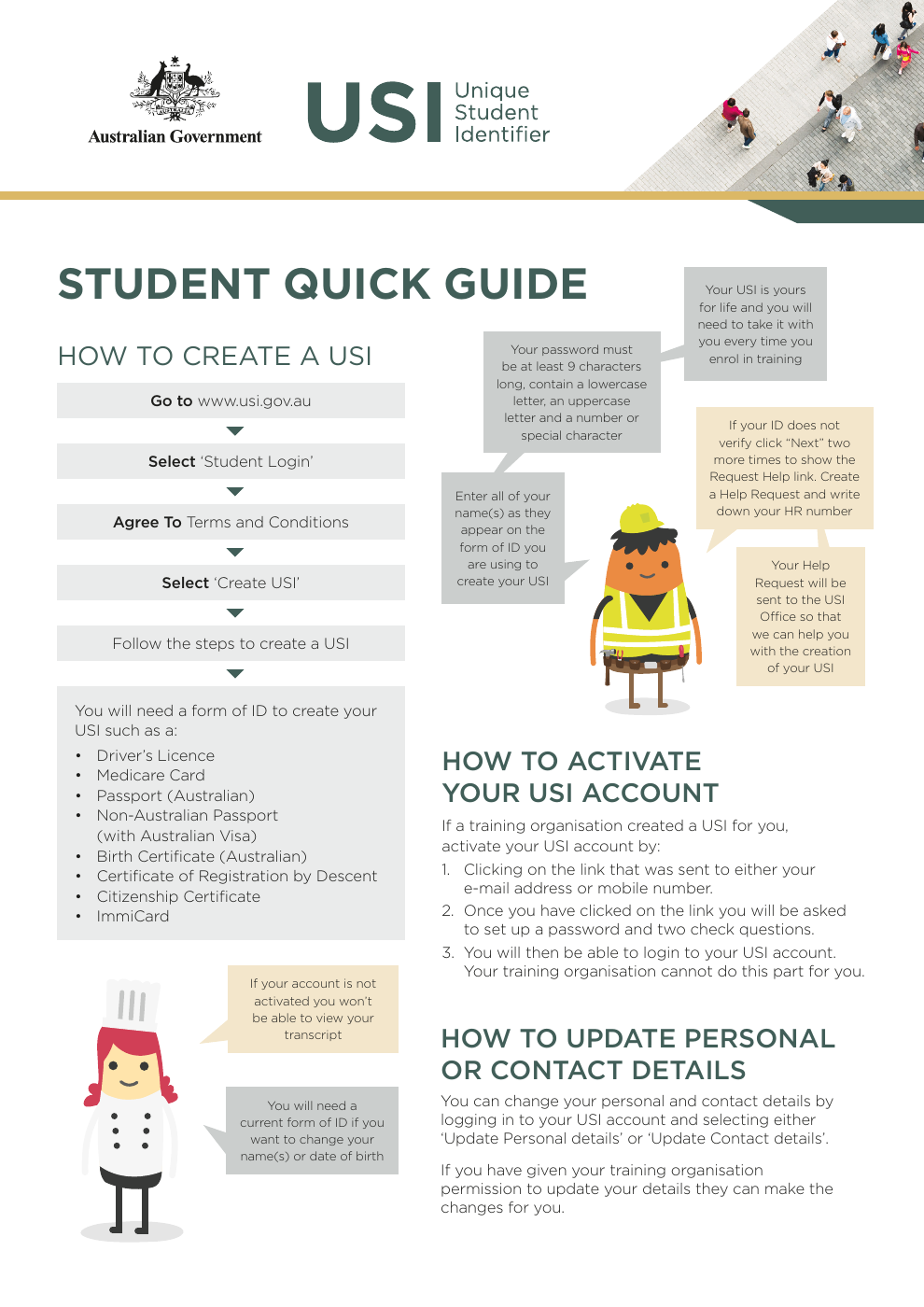 Open the USI Student Quick Guide (PDF)
The Grievance/Complaints Procedure
Step | Procedural steps for general complaints | Responsible Person |
|---|---|---|
1. | Short Courses Australia may receive complaints from students, stakeholders and members of the public through a variety of means e.g.: verbally, written documentation, electronically (email). | Complainant |
2. | Where possible all non-formal attempts shall be made to resolve the issue. This may include advice, discussions, and general mediation in relation to the issue and the complainant’s issue. Both staff and complainants are encouraged to approach the complaint openly and honestly so as to resolve problems through fair and reasonable means | All SCA Staff Complainant |
3. | Any staff member can be involved in this informal process to resolve issues but once an individual has placed a formal complaint /appeal the following procedures must be followed. | All SCA Staff |
4. | Any complainant or third party may submit a formal complaint by completing a SCA Complaint form and submitting it to Short Courses Australia. This submission constitutes a reasonable expectation that the complaint will be treated with integrity and privacy. | Complainant |
5. | Complaints are to include the following information:
The complaints form is available on the Short Courses Australia website at www.shortcoursesau.edu.au or can be sent to the complainant on request. | Complainant |
6. | Once a formal complaint is received, the RTO Manager will acknowledge receipt of the complaint in writing to the complainant and will seek to identify the issue and resolve the concern so as to avoid any further disruption to the complainant (where applicable). | RTO Manager |
7. | Once the complaints and appeals form is received the details are recorded on the complaints and appeals register which is reviewed and maintained by the Short Courses Australia RTO Manager. Information recorded on the complaints and appeals register includes:
| RTO Manager |
8. | The RTO Manger will send a written receipt to the complainant. Where a complaint refers to an individual, the individual will be informed of the complaint and invited to respond to the allegation either through discussion, or (written) correspondence. Any discussion regarding the Formal Complaint must be documented via minutes and these minutes kept on file along with details of the original complaint. | RTO Manager |
9. | The RTO Manager will investigate the complaint and the proposed resolution will be communicated to all parties involved in the complaint within ten (10) working days and agreement to the proposed resolution sought. Upon receipt of the agreement, the RTO Manager will:
| RTO Manager |
10. | Where the complaint cannot be finalised within thirty (30) calendar days, the complainant will be informed in writing of:
The RTO Manager will act immediately on any substantiated complaint. If the internal or external complaint handling or appeal process results in a decision supporting the complainant, SCA will immediately implement any required corrective and preventative actions and advise the complainant of the outcome. | RTO Manager |
11. | Any documentation including written notes of the progress of a complaint, outcomes, actions and resolution, will be kept by SCA and stored in the dedicated Complaints and Appeals folder maintained by the SCA Quality team. | RTO Manager |
12. | Complainants have the right to access advice and support from a nominated third party representation (e.g. a family member or friend, counsellor, professional representation or support person) if they require. Use of external services will be at the complainant’s expense unless authorised by the RTO Manager | Complainant |
13. | Complainants will observe strict confidentiality during all stages of the complaint’s resolution process. All communications and proceedings arising from the complaints process will remain confidential at the conclusion of the complaint’s resolution process. | Complainant |
14. | The complaints resolution process will be reviewed annually as part of the RTO continuous improvement process. | Quality Assurance and Compliance |
The Grievance/Appeals Procedure
Step | Procedural steps for appeals | Action Responsibility |
|---|---|---|
1. | Students are entitled to formally appeal the outcome of their assessment decision by completing the Appeals Form, stating their case and providing as much detail as possible, and submit this to the SCA RTO Manager either by email or post. Students are to include the following information:
The Appeals Form is available on the website at www.shortcoursesau.edu.au or can be sent to the complainant on request. | All SCA Staff Appellant |
2. | Once the Appeals Form is received the details are recorded on the Complaints and Appeals Register which is reviewed and maintained by the RTO Manager. Information recorded on the Complaints and Appeals Register includes:
| RTO Manager Appellant |
3. | Where possible, the appeal will be reviewed by a person independent of the original decision. When the appeal relates to that of an assessment decision, the decision outcome will be that either decision stands or re-assessment by a third party will occur. The third party will be another Assessor appointed by the RTO Manager. | RTO Manager |
4. | Once the process is completed, the RTO Manager shall then inform the Appellant of any decisions or resolutions reached in writing and the reasons for the resolutions. Resolutions can include but are not limited to:
The Appellant will also be provided the option of activating the external appeals process if they are not satisfied with the outcome. They are required to notify the SCA RTO Manager if they wish to proceed with the external appeals process. | RTO Manager Appellant |
External Appeals | ||
If an appellant is dissatisfied with the outcome of the internal appeals process, they may request an independent external review. Short Courses Australia will provide information regarding appropriate external review options relevant to the nature of the appeal. The appellant may also contact: Australian Skills Quality Authority (ASQA) Website: www.asqa.gov.au TAFE and Training Line (Victoria) Phone: 131 823 Short Courses Australia will cooperate fully with any external review process and will implement any decision, recommendation, corrective action or preventative action arising from the outcome. | Appellant | |
SHORT COURSES AUSTRALIA
Head Office and Melbourne Training Centre
Level 1, 300 Collins Street
Melbourne, VIC 3000
Port Melbourne Training Centre
8 Anderson St
PORT MELBOURNE VIC 3207
Sydney Training Centre
Level 3 330 Wattle Street
Sydney NSW 2007
Parramatta Training Centre
Suite 7, 410 Church Street
Parramatta NSW 2150
Global Institute of Marketing Pty Ltd trading as Short Courses Australia
ABN: 65 605 690 971 | RTO #41261 |
© 2026 Short Courses Australia. All Rights Reserved.
Handbook Disclaimer
This Student Handbook contains information that is correct at the time of printing. Changes to legislation and/or Short Courses Australia policy may impact on the currency of information included. Short Courses Australia reserves the right to vary and update information without notice. You are advised to seek any changed information and/or updates from your trainer or by contacting Short Courses Australia.
This handbook has been prepared as a resource to assist students to understand their obligations and, those of Short Courses Australia. Please carefully read through the information contained in this guide. All students need to read, understand, be familiar with, and follow the policies and procedures outlined in this Handbook. Any queries can be directed to:
This document: SCA Student Handbook V2026 1
Version Control and amendment history
Version | Release date | Details |
|---|---|---|
V2026.1 | 05.05.2026 | Update from Internal Yearly Review, and amendments to booking process |
V2025.1 | 28.04.2025 | Update From Audit Rectification |
V2025 | 21.01.2025 | Updated to privacy statement and new standards |
V2024 | 05/07/2024 | Address Change & New Year |
V2023.3 | 05/07/2023 | Validate add Transition logo |
V2023.2 | 15/06/2023 | Validate |
V2023.1 | 03/05/23 | Validate |
V2022 | 01/03/2022 | Old version |
No matching section
Try a shorter or more general search term.